Indo-West Pacific, from East Africa and the Red Sea to Japan, the Marshall Islands, New Caledonia and Australia.
Description
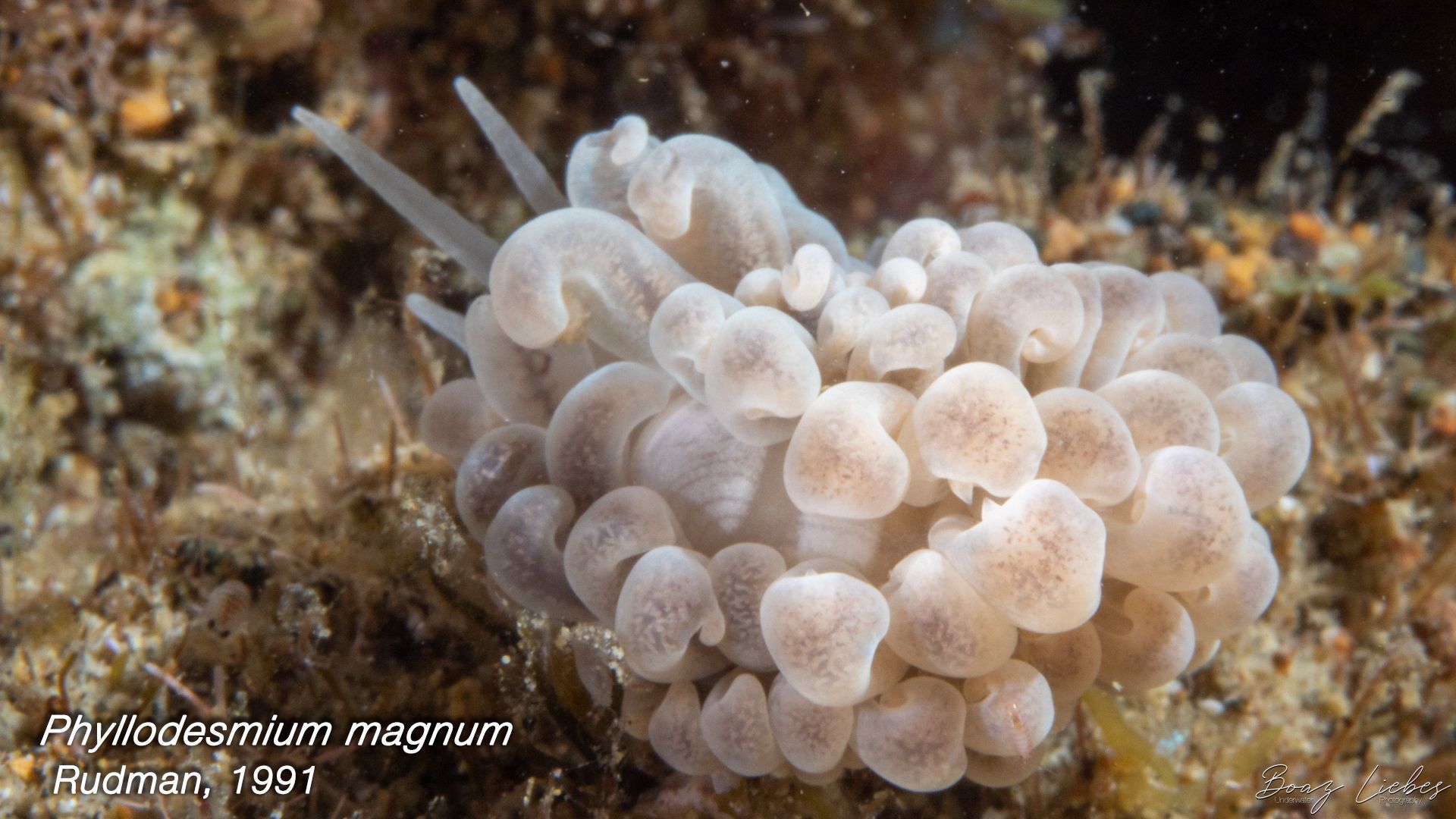
One of the largest Phyllodesmium, a solar-powered aeolid that farms zooxanthellae in chambers on the sunlit upper side of its flattened cerata. Like other members of the genus it lacks stinging cnidosacs; when disturbed it casts off its cerata, which keep wriggling and secrete a sticky mucus to distract predators.
Large, elongate aeolid with a broad foot; body translucent white tinged brown by zooxanthellae, glowing bluish lilac in reflected light. Large flattened cerata with bluntly pointed, slightly enrolled tips, set on distinct dorsal ridges. Opaque milky-yellow pigment on the front of the head, upper rhinophores, ceratal tips and foot margin; rhinophores smooth and about half the length of the oral tentacles. Some individuals are orange.
Similar species
Phyllodesmium longicirrum, also large and zooxanthellate, has many more, longer and less flattened cerata.
≈Habitat & diet
Habitat
Coral reefs, on and around colonies of the soft coral Sinularia, where it is well camouflaged.