Phyllidia ocellata — One Species or a Species Complex?
Morphological variation, species boundaries, and a comparison of observations from the Red Sea, the Solomon Islands and Romblon
Introduction
Phyllidia ocellata Cuvier, 1804 is a phyllidiid nudibranch recorded from the central Indo-West Pacific. Animals assigned to this species display striking variation in coloration, markings and dorsal tubercles. This raises a taxonomic question: do these forms represent one species, or do some belong to distinct species that have not always been recognised?
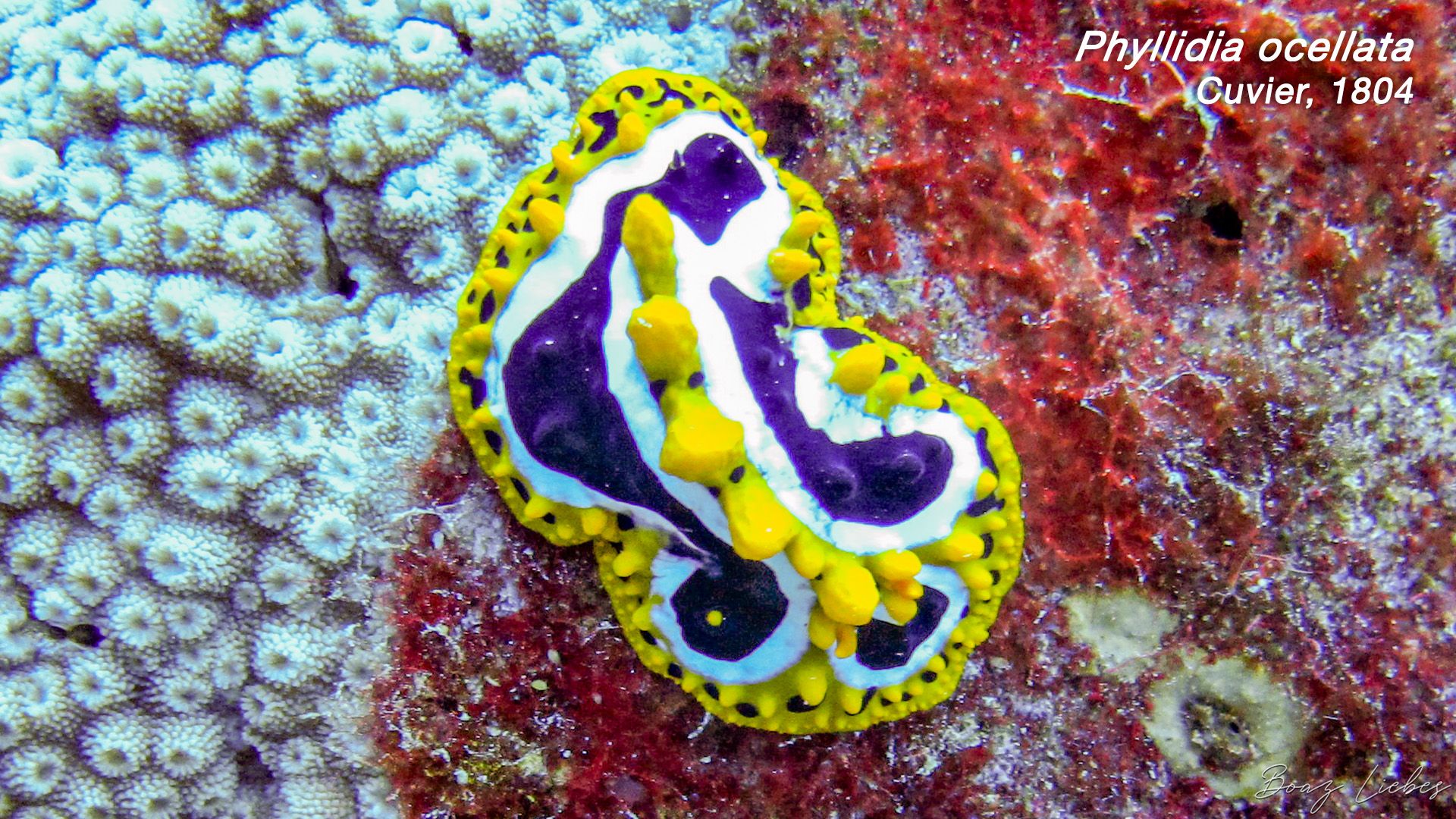
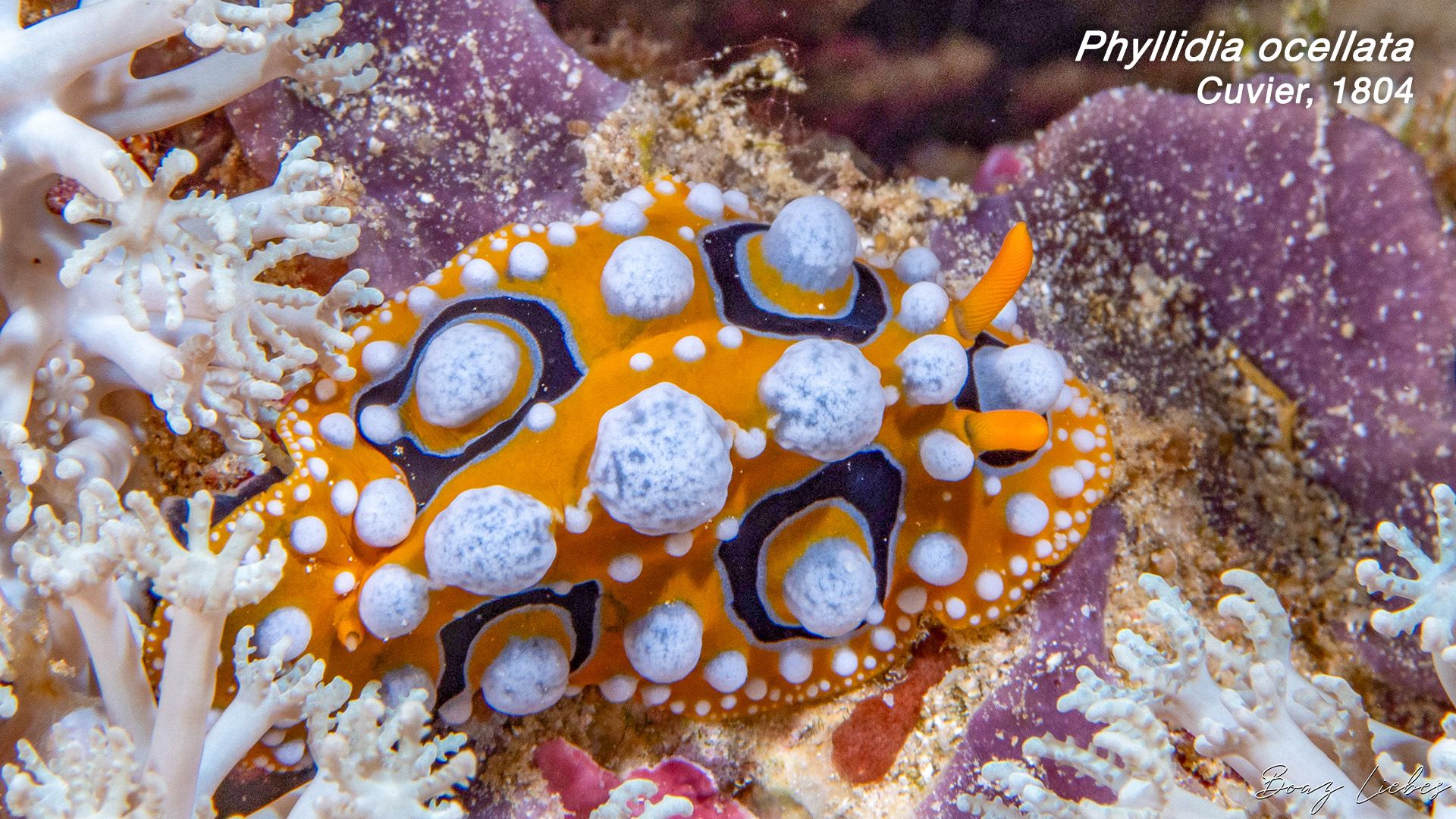
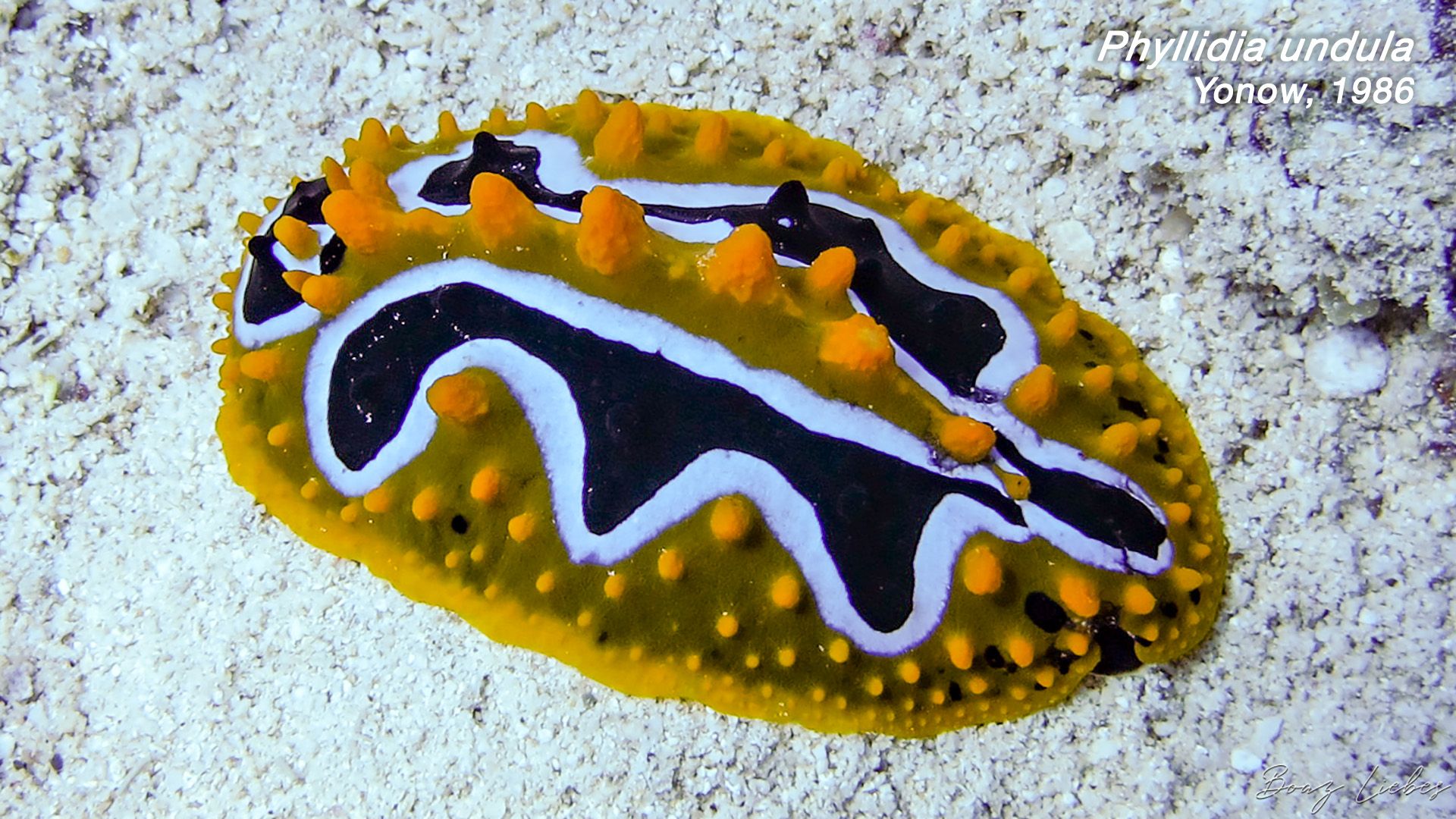
Original photographic observations from the Gulf of Aqaba, the Solomon Islands and Romblon in the Philippines illustrate this question. The detailed comparison is between the Gulf of Aqaba and the Solomon Islands, the two most different forms; the Romblon observation is included as a further example of the typical form. Two different forms were recorded in the Gulf of Aqaba: the animal in Figure 1, presented here as Phyllidia cf. ocellata, and a Phyllidia undula from the same dive site (Figure 4) — and together they illustrate the taxonomic confusion in the region well. Photographs allow external morphological comparison, but cannot replace anatomical or molecular examination.
1. Morphological comparison of the observations
| Character | Gulf of Aqaba | Solomon Islands |
|---|---|---|
| Ground coloration | Black and white centrally; yellow along margins | Bright orange |
| Central tubercles | Yellow; some elongated or closely spaced | Large, rounded, white |
| Marginal tubercles | Predominantly yellow | Small and white |
| Dark markings | Broad patches and undulating bands | Discrete rings around tubercles |
| Rhinophores | Not clearly visible | Orange and lamellate |
The Solomon Islands animal closely resembles the familiar ringed form of P. ocellata. The Gulf of Aqaba animal differs not only in colour but also in the arrangement of dark markings and dorsal tubercles. Differences between two photographed animals, however, cannot by themselves establish that they represent separate species.
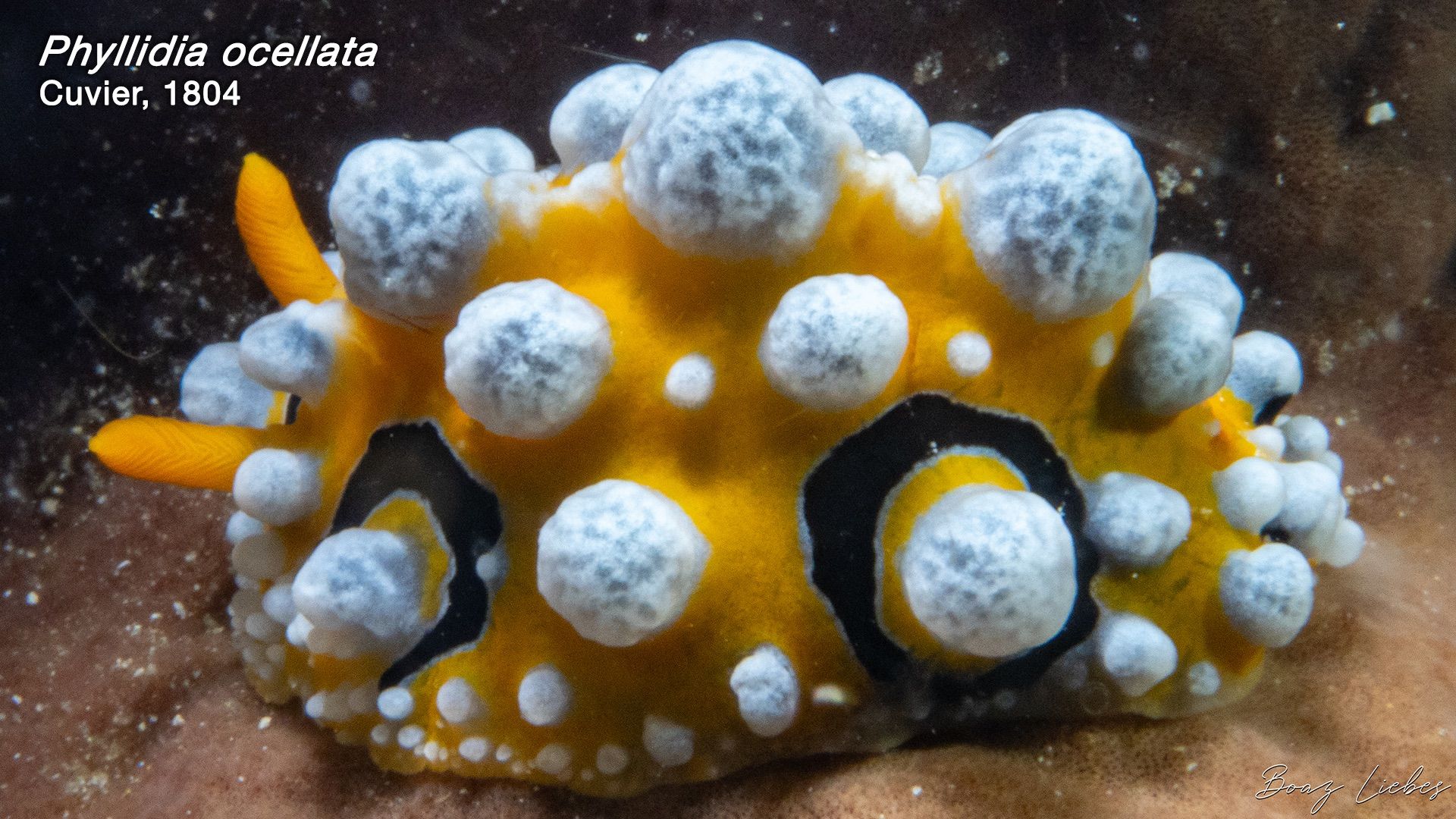
A note on the Romblon observation. The animal photographed in Romblon, Philippines (January 2026, Figure 3) closely resembles the Solomon Islands animal: a yellow-orange ground colour, large rounded white tubercles, black rings edged with white around some tubercles, and orange lamellate rhinophores. Both match the classic form of the species in the centre of its range and illustrate the consistency within that region — in contrast to the Gulf of Aqaba animal.
2. Two forms from Eilat: P. cf. ocellata and P. undula
A closely related species is known from the Red Sea, Phyllidia undula Yonow, 1986, which until fairly recently was treated as a subspecies of P. ocellata. Its identification has passed through several stages:
- 1986 — described as a subspecies. Nathalie Yonow published a review of the Red Sea Phyllidiidae in which she first described the taxon, from the Red Sea, as a subspecies of P. ocellata under the name Phyllidia ocellata undula. The name undula refers to the wave-like, meandering pattern of the dark markings on the dorsum.
- 1993 — back within P. ocellata. In his revision of the family, Brunckhorst (1993) treated undula as one of the colour forms of P. ocellata in which the black areas expand and meander across the dorsum. Later work followed this, identifying Red Sea animals as P. ocellata (e.g., Fahrner & Schrödl 2000).
- 1996–2012 — an anatomical difference. In her Indian Ocean work, Yonow placed the undula form in the Phyllidia multituberculata group and noted an anatomical difference: the pharyngeal bulb is segmented and asymmetrical in this group, whereas in Pacific P. ocellata it is symmetrical.
- Today — a distinct species. WoRMS accepts Phyllidia undula Yonow, 1986 as a distinct species, and the name Phyllidia ocellata undula is no longer accepted; the status source given is Sea Slugs of the Red Sea (Yonow 2008). The Red Sea check-list of Phyllidiidae (Yonow 2020) includes P. undula, distributed in the Red Sea and along the East African coast and among the most frequently photographed Red Sea phyllidiids, whereas P. ocellata does not appear in the list.
Comparing the two Eilat animals
| Character | Figure 1 (P. cf. ocellata) | Figure 4 (P. undula) |
|---|---|---|
| Dorsal ground | White over most of the centre; yellow only at the margins | Yellow-orange over most of the dorsum |
| Dark markings | Broad patches edged with wide white bands; posteriorly they close into patches around a tubercle | A wavy, meandering black band along the dorsum, edged with a narrow white line |
| Central tubercles | Yellow, large and elongated, in a row along the midline | Orange and conical, scattered over the yellow ground |
| Margin | Yellow band with small tubercles and black spots | Small orange tubercles and a few black spots |
Two interpretations
The literature is divided on exactly the question these Eilat observations raise:
- Forms of one species. In the approach of Brunckhorst (1993), also followed by Bill Rudman on the Sea Slug Forum, the Red Sea form is a colour form of P. ocellata, and the forms grade into one another. Rudman cited a Red Sea animal in which the black patches on each side break up into spots surrounded by a whitish ring — an intermediate between undula and the ringed form. Under this interpretation both Eilat animals are P. ocellata.
- Two species. According to Yonow and to WoRMS today, P. undula is a separate species and P. ocellata is not recorded from the Red Sea at all. Under this interpretation the animal in Figure 4 is P. undula, and the animal in Figure 1 is either an unusual form of P. undula or a rare Red Sea record of P. ocellata.
The animal in Figure 1 differs clearly from the one in Figure 4, yet it does not match the classic ringed form of P. ocellata (Figures 2 and 3) well either. Posteriorly it shows dark patches closing around a tubercle — a feature of the ringed form — and it is therefore presented here as P. cf. ocellata: comparable with P. ocellata, but without a firm identification. The main anatomical difference between the groups, the structure of the pharyngeal bulb, cannot be seen in a photograph, so the photographs cannot decide between the interpretations.
Identification status: The Solomon Islands and Romblon animals match the typical form of P. ocellata. The Gulf of Aqaba animal in Figure 1 is identified as Phyllidia cf. ocellata; it may be a form of P. undula. The animal in Figure 4 is identified as P. undula. None of the photographed animals has been genetically tested.
3. What do molecular studies tell us?
Integrative study of the family (Papu et al. 2022)
This study combined two mitochondrial genes (CO1 and 16S), external morphology and chemical profiles, based on hundreds of specimens collected in Sulawesi, Indonesia. For P. ocellata it offers two lessons:
- Colour variation does not require a separate species. An almost entirely dark animal, first identified as another species (P. madangensis), fell within the P. ocellata genetic lineage. Genetic variation within the species was about 5%, and up to about 10% when one divergent branch was included.
- External similarity does not guarantee a single species. Animals looking almost identical to P. ocellata formed a separate genetic lineage (labelled P. cf. babai) and also had a different chemical composition.
Different species-delimitation methods gave different results. In the analysis the authors adopted, all P. ocellata specimens formed a single species; other methods (bPTP) split the family, and P. ocellata in particular, into many "species", which the authors regarded as over-splitting. Genetic distance alone is therefore insufficient: the more informative questions are whether distinct lineages exist, whether they are supported by nuclear markers, and whether they correspond to morphological characters and geography. Note that the study was based on material from Sulawesi and did not include Red Sea specimens.
Study of Indian material (Dixit et al. 2023)
This study presented the first molecular data for the family from India. Indian P. ocellata sequences closely matched those from the Pacific. One animal, considered from its appearance to be a colour form of P. multituberculata, turned out to be P. ocellata only after dissection and molecular analysis. The study shows that identification by colour alone can mislead in both directions.
These studies do not show that every reported form throughout the Indo-Pacific has been genetically verified — and in particular not the Red Sea forms.
4. Potential mechanisms underlying the variation
Genetic polymorphism. Inherited variants within a single species may contribute to differences in colour pattern or body morphology.
Phenotypic plasticity. The same genotype can express different phenotypes under different environmental conditions. Diet, physical conditions and genotype-by-environment interactions are possible mechanisms, but they have not been shown to explain the specific forms photographed here.
Ontogenetic change. Appearance may change with growth and development without necessarily representing an environmental response.
A species complex. Some forms historically assigned to one species may represent independently evolving lineages. The history of the name P. undula — described as a subspecies of P. ocellata, merged with it, and later placed in the P. multituberculata group — highlights the need to investigate this possibility.
5. How can species boundaries be tested?
Integrative taxonomy combines comparative study of tubercles and pigmentation, internal anatomy, mitochondrial and nuclear DNA sequences, phylogenetic analysis, geographic distribution and ecological data. If contrasting forms consistently correspond to independently supported genetic lineages, the hypothesis of multiple species becomes stronger. If forms are distributed across the same genetic lineages, intraspecific variation becomes more plausible.
For these observations, the next steps are to compare both Eilat animals with the original description (Yonow 1986) and with reliably identified Red Sea images, looking for intermediate forms between them; to check whether genetic sequences of Red Sea P. undula and of P. ocellata-like Red Sea animals have been published, and to compare them with P. ocellata sequences from the Pacific and India; and, where possible, to examine anatomical material, especially the pharyngeal bulb.
6. Conclusion
The differences between the Gulf of Aqaba animal in Figure 1 and the Solomon Islands and Romblon animals are large and clear, but they do not by themselves establish two species. Two different forms were recorded in the Gulf of Aqaba itself, and the literature is divided on whether Red Sea forms belong to P. ocellata or to the separate species P. undula. The animal in Figure 1 is therefore presented as P. cf. ocellata, and the observations should not be presented either as proof of intraspecific variability in P. ocellata or as proof of two species.
Well-documented photographs from widely separated regions can identify important taxonomic questions, while their resolution requires morphological, anatomical and molecular evidence — in this case, above all, genetic samples from the Red Sea.
Observations on the site
- Phyllidia cf. ocellata from the Gulf of Aqaba (Figure 1)
- Solomon Islands animal (Figure 2)
- Romblon animal (Figure 3)
- Phyllidia undula from the Gulf of Aqaba (Figure 4)
References and links
- Brunckhorst, D. J. (1993). The systematics and phylogeny of phyllidiid nudibranchs (Doridoidea). Records of the Australian Museum, Supplement 16: 1–107. doi:10.3853/j.0812-7387.16.1993.79
- Dixit, S., Yonow, N., Venugopal, V. K., Manjebrayakath, H. & Saravanane, N. (2023). The curious case of Phyllidia ocellata and the first molecular data of three phyllidiid species from India (Gastropoda, Heterobranchia, Phyllidiidae). Molluscan Research. Abstract
- Fahrner, A. & Schrödl, M. (2000). Redescription of Phyllidiopsis sinaiensis (Yonow, 1988), with a review of the Red Sea Phyllidiidae. Journal of Molluscan Studies 66: 467–476. doi:10.1093/mollus/66.4.467
- Papu, A., Bogdanov, A., Bara, R., Kehraus, S., König, G. M., Yonow, N. & Wägele, H. (2022). Phyllidiidae (Nudibranchia, Heterobranchia, Gastropoda): an integrative taxonomic approach including chemical analyses. Organisms Diversity & Evolution. doi:10.1007/s13127-021-00535-7
- Rudman, W. B. (2003, July 26). Comment on "An ocellate 'Phyllidia undula' from Red Sea" by Chris Quinn. Sea Slug Forum, Australian Museum, Sydney. Message
- Yonow, N. (1986). Red Sea Phyllidiidae (Mollusca, Nudibranchia) with descriptions of new species. Journal of Natural History 20(6): 1401–1428. doi:10.1080/00222938600770941
- Yonow, N. (1996). Systematic revision of the family Phyllidiidae in the Indian Ocean Province: Part 1. Journal of Conchology 35(6): 483–516.
- Yonow, N. (2008). Sea Slugs of the Red Sea. Pensoft, Sofia–Moscow. 304 pp.
- Yonow, N. (2012). Opisthobranchs from the western Indian Ocean, with descriptions of two new species and ten new records (Mollusca, Gastropoda). ZooKeys 197: 1–129. doi:10.3897/zookeys.197.1728
- Yonow, N. (2020). Red Sea Opisthobranchia 6: Phyllidiidae and their paradorid mimic: new species and new records (Heterobranchia, Nudibranchia, Doridina). ZooKeys 1006. doi:10.3897/zookeys.1006.59732
- World Register of Marine Species (WoRMS): Phyllidia ocellata; Phyllidia undula; Phyllidia ocellata undula.
- Australian Museum, Sea Slug Forum: Phyllidia ocellata, including messages on the "undula" form from the Red Sea.
Editorial note: Links point to relevant publications and databases. Bibliographic details should be checked against the sources, and comparisons made with type material, before formal scientific publication.